

Panran’s PR7XX Series Precision Digital Thermometer Guide
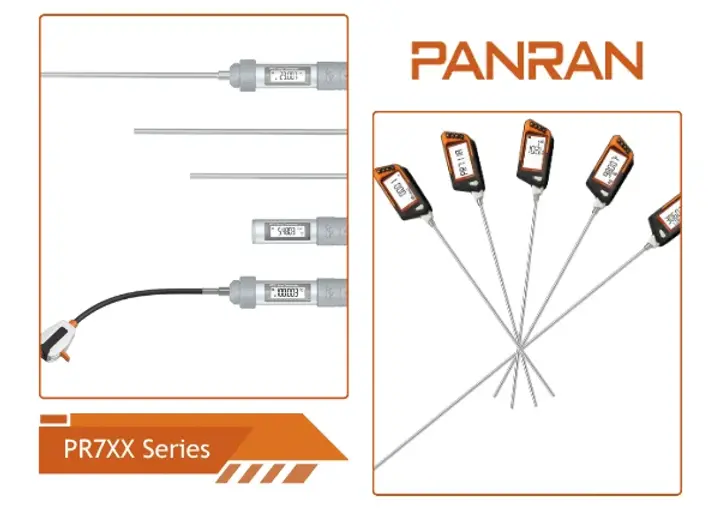
PR710 vs PR721/PR722: Quick Comparison
Feature | PR710 (Standard handheld) | PR721/PR722 (Modular platform) | “Reference-class” peers (Fluke/WIKA) |
Display resolution | 0.001 °C selectable | 0.001 °C | Up to 0.002–0.03 °C class (model dependent) |
Sensor support | Integrated wire-wound Pt100 | Swappable “intelligent” lock-type sensors: PRT (Pt100), thermocouple, humidity | Fluke 1524: PRT/thermocouple/thermistor; WIKA CTH6500/7000: Pt100/thermistor |
Typical range | Model-dependent: ~–60…300 °C across variants | –200…1300 °C via sensor modules | Fluke 1524: supports wide ranges via probe; WIKA handhelds: up to –200…+650 °C (model-dependent) |
Wireless/comms | 2.4 G wireless via PC dongle; long AAA life | Bluetooth® or ZigBee®, app sync; U-disk (USB mass-storage) | Varies by model |
Ingress / EX | — | IP64, CNEx explosion-proof option | WIKA CTH6500 has an intrinsically safe variant; varies |
Power | 3×AAA, ultra-low power; 1400 h (wireless off) | Rechargeable Li-ion; ≥80–120 h | Varies |
Data logging | Up to hundreds of thousands of points (model-dependent) | Onboard memory + U-disk export | Yes, model-dependent |
Which Panran thermometer should I buy?
Choose PR710 if you want a handheld precision thermometer with Pt100 and very long runtime for routine checks.
Choose PR721/PR722 if you need modular probes (PRT/thermocouple/humidity), app connectivity (Bluetooth/ZigBee), IP64, U-disk data export, or explosion-proof capability.
How Precision Thermometers Work
PRT (Pt100) thermometers measure resistance change in a platinum element; they offer the best stability and low drift. Thermocouples (TCs) generate a small voltage from two dissimilar metals; they cover wider ranges (up to ~1300 °C with Type S/N on PR7XX) but require cold-junction compensation at the readout.
The meter linearises inputs (ITS-90 tables or polynomials), applies calibration coefficients, and outputs temperature with a set resolution (e.g., 0.001 °C). On PR7XX, the reference junction compensation for TCs is specified and contributes to uncertainty.
Choosing the Right Probe & Sensor
Match the probe to your range, accuracy target, environment, and connectivity:
Range: cryogenic/freezer work (down to –80/–200 °C) → PRTs; high-temp process checks (to ~800–1300 °C) → TCs. On PR721/PR722, the intelligent sensor range spans –200…1300 °C depending on module.
Accuracy: for tight tolerances, use wire-wound Pt100 PRT probes; for mapping and high-temp verification, TCs are practical.
Environment & IP: wet or dusty sites need IP64 on PR721/PR722.
Explosion-risk: select CNEx-certified PR721/PR722 configurations.
Data & app: prefer Bluetooth/ZigBee for live sync and U-disk for quick exports. cspanran.com
Australian Requirements & Good Practice
Food & Beverage (HACCP/FSANZ): Keep potentially hazardous foods at ≤ 5 °C or ≥ 60 °C; the “danger zone” is 5–60 °C. Use the 2-hour/4-hour rule when food must be outside control during prep or display.
GMP (TGA/PIC/S): Manufacturers must maintain controlled processes, equipment calibration and qualification, and documented records aligned to the PIC/S Guide to GMP adopted in Australia (Version 16 in 2024, moving to Version 17 in 2025). Temperature control and documented calibration are routine compliance expectations.
NATA guidance (selection of references): A reference thermometer’s uncertainty should be ≤ 1/5 of the uncertainty required for the working thermometer—practical for setting targets during validation and calibration planning.
Calibration & Traceability in Australia
CISCAL is NATA-accredited (Accreditation No. 411) to ISO/IEC 17025 and performs digital thermometer calibration from –80 °C to 1100 °C, as well as verification of controlled temperature enclosures (e.g., ovens, furnaces, incubators, baths, freezers) with AS 2853 references where applicable. Expanded uncertainty (≈95% confidence) is reported on certificates, together with traceability.
How often to calibrate?
Baseline: annually for most lab and QA uses.
GMP critical control / release: 6–12 months depending on risk, load, and audit history.
Harsh use (high-temp cycling, shocks): shorten intervals (e.g., quarterly).
These intervals align with risk-based GMP expectations under the PIC/S Guide.
How We Calibrate PR7XX (method snapshot)
Sources: dry-well calibrators for field checks and stirred liquid baths for best stability at low/medium temps.
References: reference readout (e.g., PR722B) with calibrated PRT thermometer; ambient temperature/humidity tracking; comparison and electrical input checks where required.
Reporting: results with expanded uncertainty, traceability, and digital certificates issued via the CIS CAL SMART portal.
Coverage: field service hubs in NSW, VIC, QLD with national reach.
Setup, Logging & Connectivity (PR7XX)
Wireless: PR721/PR722 supports Bluetooth or ZigBee for app sync; U-disk mode (micro-USB) for mass storage and quick data copy. PR710 can form a 2.4 G wireless link to a PC dongle for multi-unit monitoring.
Best-practice logging: for temperature stability checks, log at 1–5 s; for routine trending, 30–60 s balances data volume and insight. For food safety, ensure logs prove time outside control comply with 2-hour/4-hour guidance.
Buying Checklist
Accuracy class and uncertainty target (remember the 1/5 rule for references).
Sensor compatibility: Pt100/PRT thermometer, thermocouple thermometer, humidity.
Ingress protection/IP rating: need IP64 thermometer?
Explosion-proof requirement (CNEx).
Data logging capacity and U-disk data export.
Connectivity: Bluetooth/ZigBee.
Battery/runtime: AAA vs rechargeable.
Calibration on delivery: request ISO/IEC 17025 NATA-traceable certificates.
Warranty & service: confirm local NATA-accredited support and national coverage.
Panran Equipment Used in Calibration
Getting the Most Value from Your CISCAL services
Why CISCAL for PR7XX? We combine supply, probes, and NATA-traceable calibration with digital certificates via the CIS CAL SMART portal—ideal for GMP temperature mapping, HACCP verification, and laboratory QA. Our accredited scope covers –80 °C to 1100 °C for digital thermometers and temperature enclosures verification against AS 2853 where applicable, backed by Accreditation No. 411 and national coverage from NSW/VIC/QLD hubs.
Get NATA-traceable calibration & supply in Australia. CISCAL has 60+ years of ISO/IEC 17025 accreditation (No. 411) with national coverage. We calibrate PR7XX systems, supply probes, and issue digital certs via the CIS CAL SMART portal.