

Modular Control, Reliable Output: Inside COLLIN Extruders

What is a COLLIN Extruder?
COLLIN single-screw extruders are compact lab and pilot machines used to turn pellets or powder into filaments, strands, films and tubes ideal for screening resins, small-lot compounding, process development and pilot production.
The core families are:
Series | Plain-English use case | Typical features |
E — Entrance (LAB•LINE) | Cost-efficient lab/R&D and QC | Compact lab frames; suitable for polyolefins and many technical polymers; swap dies and downstream easily. |
P — Professional (LAB•LINE) | Modular all-rounder for R&D, pilot and small batches | Screw diameters from 12–60 mm; optional high-temperature designs to 500 °C; touchscreen control. |
T — High-torque/High-speed (PILOT•LINE) | Higher output for pilot/production | Torque drive up to ~800 rpm; max temp 500 °C; compact build for multi-layer lines. |
Medical Line | Cleanroom-ready tubing, including multi-lumen catheters | Medical-grade design, validation/qualification documentation; SCADA options aligned with GAMP; multi-lumen up to 7 channels, <100 µm diameters possible. |
Teach Line | Table-top training/QC and quick screenings | Single-screw table-top units with HMI; typical max temp ~300 °C. |
Why Australian Teams Choose COLLIN
Modular and scalable. You can start with an E or P extruder and add or swap dies, pumps and downstream (e.g., water bath, pelletiser, flat/blown-film, tube line) as projects evolve—handy for shared university labs and grant-funded upgrades.
Wide process window. P and T machines are offered in high-temperature builds up to 500 °C (air-cooled) for polymers like PEEK and fluoropolymers, and standard builds ~350–400 °C—useful for high-performance and filled formulations.
Digital control that fits lab QA. Touch HMI is standard; Medical Line literature notes SCADA solutions per GAMP for data integrity and batch records—useful where ISO 13485/QMS evidence is needed.
Local relevance. Australia’s R&D and manufacturing teams are chasing productivity and recycled-content targets while budgets stay tight. ABS industry reporting for 2023–24 highlights productivity and capex signals many labs watch when justifying equipment upgrades.
Recycling and circular trials. Government reporting shows plastics recovery remains limited (hundreds of kilotonnes recovered in 2023–24), keeping lab-scale trials and rheology work in focus for recycled feedstock validation. COLLIN’s small-lot lines are well-suited to this.
Meet COLLIN at K 2025 (8–15 Oct 2025, Düsseldorf) – Hall 9, Stand B16
When & where: K 2025 runs Wednesday 8 to Wednesday 15 October 2025 at Düsseldorf, Germany. Visitors enter 10:00–18:30 daily. Map from Interactive hall plan:
Find COLLIN: Hall 9 • Stand B16 on the official exhibitor profile and interactive hall plan.
Tickets & planning:
Buy tickets and register visitors in advance on the K site (personalised e-tickets).
Use the Hall & Site Plans to map a route (Hall 9 is beside North entrances).
Opening hours can get tight with long aisles—block 2–3 hours just for Hall 9 if you plan demos.
Getting there (AU reader tips):
From Düsseldorf Hbf: take U78 (Messe Nord/Entrance North) or U79 (Messe Ost/Entrance East); Bus 722 also serves the grounds.
Shuttles run from carparks to entrances; signage is strong in English.
Long-haul travellers: aim to arrive 1–2 days earlier to buffer jet lag and check your badge at off-peak hours.
Accommodation: if you’re short on time, look for stays near Stockum/Lohausen or around Nordpark to keep transfers under 20 minutes.
What to expect:
K is marketed as the world’s No.1 plastics & rubber fair with ~3,000 exhibitors; official pages confirm dates and daily opening times. Build your shortlist and pre-schedule demos.
Series at a Glance
E — Entrance (LAB•LINE)

Best for: cost-efficient lab R&D/QC, resin screening and method development.
Typical window: standard builds to ~350 °C; high-temp design to ~400 °C; touch HMI with melt temp/pressure, speed and current display.
Hardware sizes: 12, 16, 20, 25, 30, 45 mm nominal diameters; compact on a moveable cabinet for small bays.
Materials: polyolefins and many technical polymers (non-abrasive/corrosive fillers).
P — Professional (LAB•LINE)

Best for: modular all-round R&D, pilot, and small-batch production; easy to scale with dies, pumps and downstream (film, strand, tubing).
Typical window: up to 400 °C (air-cooled) / 350 °C (water); high-temp design up to 500 °C (air) / 450 °C (water).
Hardware sizes: 12–60 mm nominal diameters with options like barrier screws, heated flange, grooved feed and extra sensors.
Controls & data: touch HMI with recipe management, Ethernet/fieldbus and optional SCADA connection.
Safety: monitoring per EN 1114-1; example spec shows 560 bar pressure switch-off (PL c).
Materials: polyolefins, technical polymers, highly filled, fluoropolymers, biopolymers; COLLIN literature also references high-temp polymers like PEEK in technique notes.
T — High-torque/High-speed (PILOT•LINE)
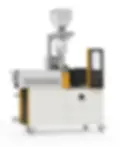
Best for: higher output/pilot and near-production runs; good for multi-layer lines.
Drive & speed: torque motor up to ~800 rpm, maintaining high torque at speed for higher throughputs.
Typical window: up to 500 °C; same HMI/recipe style and SCADA connectivity as P.
Tech data: listed T models include E25 T and E30 T; ask for current diameters and throughput windows for your resin.
Safety: function monitoring per EN 1114-1 with temperature-controlled zones and the same 560 bar switch-off reference (PL c).
Materials: covers fluoropolymers, high-temperature plastics and highly filled mixes.
Medical Line

Best for: cleanroom-ready tube/catheter development, pharma and selected food projects where hygiene and documentation matter.
Tubing scope: multi-lumen and multi-layer tubes; diameter spectrum from <100 µm to ~5 mm; up to 5 layers with co-extrusion.
Controls & data: SCADA per GAMP noted in literature; request validation/qualification documentation pack for ISO 13485-style environments.
Portfolio note: extruders, compounders, calenders, presses and pelletising can all be supplied in MEDICAL•LINE versions to match your URS.
Teach Line

Best for: education, apprenticeship, QC and quick material screenings where small footprints and low material use are priorities.
Form factor: table-top single-screw extruders with high parameter control; companion Teach Line modules include blown-film, tube, water bath and pelletiser.
Material & Temperature Pointers
• If you’re targeting fluoropolymers or PEEK/PPSU, shortlist P (high-temp) or T with 450–500 °C capability and appropriate screws/barrels.
• For biopolymers and small-lot compounding, E or P with simple downstream (strand/pelletiser) keeps trials affordable.
Compliance & Safety for Australian Labs
Machine safety. When specified to EU norms, extruders can be configured to the EN 1114-1 safety framework for plastics and rubber screw extruders, covering significant hazards, guarding and interlocks across extruders, feeders and ancillary gear like screen changers and pumps. Your procurement brief should call this out.
Medical manufacturing. For med-tech teams working under ISO 13485, the Medical Line documentation provides validation/qualification support, as well as SCADA alignment with GAMP, which is helpful for device records and audits relevant to TGA pathways in Australia. Also see TGA guidance on QMS audits and common nonconformities to plan document trails.
University & enterprise procurement. AU institutions typically require “safe procurement of plant” procedures that consider guarding, isolation, training and documentation at purchase. A good example is UQ’s Safe Procurement and Acquisition of Plant and Equipment procedure.
Common Australian Applications
Plastics & recycling R&D. Small-lot compounding, pressure-filter tests, film/tube trials and rheology studies for recycled content and additives enabled by modular downstream (water baths, pelletisers, flat/blown-film).
Medical tubing & biomaterials. EVA, Pebax, TPU and fluoropolymers/PTFE are typical; multi-lumen catheter geometry up to 7 channels, with co-extrusion up to 5 layers and medical-grade materials and surfaces suited for cleanrooms.
Food & feed. The Medical Line umbrella also covers designs for pharma and food (including pet)—useful where hygienic materials and cleanability matter.
Picking the Right COLLIN Extruder
Material class & melt temp: commodity, engineering, fluoropolymers/PTFE, PEEK, biopolymers → consider P/T with high-temp (to 500 °C).
Throughput target: lab screening vs pilot output → E/P for lab & small batches; T for higher output.
Screw diameter & rpm window: 12–60 mm diameters across P series; T offers ~800 rpm.
Filtration/venting: call out screen changers, vented barrels and gear pumps for recyclate/fillers. (Scope covered under EN 1114-1 hazard coverage for ancillary equipment.)
Downstream needed: strand/pelletiser, flat or blown film, tubing, water bath.
Cleanroom/QMS: Medical Line with cleanable surfaces, documentation and SCADA; align to ISO 13485 file structures.
Data & recipes: HMI recipes and optional SCADA for records, auditability and repeat runs.
Use case: training vs R&D vs pilot → Teach Line / E / P / T mapped accordingly.
Example Configurations for AU Use Cases
University Polymer Lab Teach Line extruder or E-series + water bath/strand pelletiser + simple flat/blown-film die. Compact footprint suits teaching bays; easy changeovers help with class rotations.
Med-device Pilot Medical Line or P-series with multi-lumen die, closed guarding, inline measurement, recipe/SCADA for batch records and equipment logs aligned with ISO 13485 documentation.
Recyclate R&D P-series with higher torque options, vented barrel and melt filtration, plus pelletising; add blown-film or tube take-off for property screening on recycled blends.
Ongoing Support in Australia
For installation, training, calibration and maintenance across Australia, CISCAL provides national coverage with NATA-accredited services (ISO/IEC 17025, Accreditation No. 411) and offices in NSW (Seven Hills), VIC (Epping) and QLD (Meadowbrook). The team supports site readiness, operator training, periodic calibration and documentation sign-offs.
If you prefer to purchase through a local extrusion specialist, Extruders Australia is a partner promoting COLLIN Lab & Pilot Solutions locally and can coordinate demonstrations.
Get a Custom Spec
Ready to spec a COLLIN extruder for your Australian lab or pilot line? Our team maps E/P/T/Medical/Teach configurations to your materials, EN 1114-1 safety expectations and cleanroom/QMS needs, and coordinates local installation, training and calibration.
Book a consult—or meet us at K 2025, Hall 9 • Stand B16 (8–15 Oct, Düsseldorf) for live demos.