

Laser Calibration: When and How to Do It

Use a risk-based interval typical practice: 6 to 12 months for regulated work; shorter if critical, high-use, or harsh environments. A fixed number isn’t mandated by ISO/IEC 17025, intervals must be justified and records kept.
What triggers a calibration? On installation/commissioning, after any impact/repair, after major software/firmware changes, when drift is detected, and at your defined interval.
Audit-ready results in Australia: Use labs with NATA-endorsed certificates showing SI traceability via Australia’s National Measurement Institute (NMI), with measurement uncertainty reported.
What is Laser Calibration?
Laser calibration is a comparison of your instrument’s readings against a more accurate, traceable reference to quantify error and report expanded uncertainty (95% confidence). In Australia, NATA requires metrological traceability to SI units, typically through NMI, and ISO/IEC 17025 sets the competence framework labs are assessed against.
Common Categories:
Dimensional: Laser interferometry for machine tools/CMM axes; generates compensation tables to correct positioning errors.
Radiometric: Laser power/energy meters verified against NMI-traceable standards; checks responsivity and linearity.
Spectral: Wavelength checks of lasers/wavelength meters against stabilised references or transfer standards; uncertainty stated in nanometres per the lab’s scope.
Beam diagnostics: Beam profile/divergence/M² checks to ensure process or research performance matches spec.
Construction lasers (levels): Practical level/line checks and, if out, full lab calibration.
Compliance in Australia
NATA & ISO/IEC 17025: NATA accredits labs to ISO/IEC 17025, providing independent assurance that methods, uncertainty, and traceability are sound. NATA-endorsed certificates are widely recognised, including via ILAC.
Traceability & uncertainty: NATA’s Metrological Traceability Policy explains how results must be linked to national standards (commonly NMI) and how uncertainty is established and reported.
Laser safety labelling/classification: Follow ARPANSA guidance and AS/NZS IEC 60825 series (equipment classification, user guidance).
Workplace controls (construction): Safe Work Australia states Class 3B and 4 lasers must not be used for construction work. Use Class 1/1M/1C/2/2M/3R only.
Sector drivers: TGA adopts PIC/S GMP for medicines (calibrated, traceable instruments and records); FSANZ requires at least one thermometer accurate to ±1 °C in food businesses (handy for instrument verification in HACCP).
When to Calibrate: By Risk & Use Case
Set intervals with evidence. Consider safety/quality risk, usage hours, environment (heat, vibration), historical drift, firmware changes, and audit expectations. Document the rationale in your SOP.
Application | Typical triggers | Suggested interval (guide only) | Standard/driver |
Machine tools / CMM axes | Commissioning, after crash or ball-screw work; tolerance changes | 6–12 months for production; shorter if tight tolerances | |
Laser power/energy meters | Before validation/R&D campaigns; after sensor replacement/impact | 6–12 months; verify at operating wavelengths and expected ranges | NATA traceability via NMI optical services; lab scopes list ranges/uncertainties. |
Wavelength meters/spectrometers | Before critical experiments; after firmware/hardware change | ≈12 months for regulated labs; risk-based in research | |
Construction laser levels | After drops/shock; if site check fails | Site check monthly; lab calibration as per contract/spec | Field check per RedBack method; if out, book NATA calibration. |
How to Calibrate: Procedures and Checklists
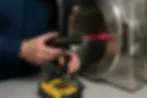
A. Laser Interferometry (Machine Positioning)
What you’re doing: Using a laser interferometer (or tracker with interferometry) to measure linear errors, backlash, straightness, squareness, pitch/yaw/roll and then generating axis compensation tables in the controller.
Set-up essentials (checklist):
Stable environment (temp, air flow); warm-up machine and optics.
Align optical path; use a retroreflector/SMR or plane mirror targets.
Log environmentals (air temp/pressure/humidity) for refractive index compensation.
Verify laser reference status and traceability; check beam quality.
Run-through (summary):
Baseline sweep on each axis (up/down) for linear error and reversal.
Cross-tests for straightness and squareness.
Rotary/axis tests if applicable.
Upload compensation tables; re-run for as-left verification; issue uncertainty-backed report.
Many Australian shops use systems like Renishaw XL-80 or API trackers; both depend on interferometry with traceable wavelength standards.
B. Laser power/energy meters
Aim: Compare DUT readings to a NATA-traceable reference at relevant wavelengths and power/energy levels; check linearity and responsivity; report expanded uncertainty (k≈2). Use NMI-traceable standards or transfer artefacts.
Steps (bench):
Inspect sensor head; confirm damage/contamination-free.
Stabilise source; set wavelength compensation.
Apply points across the working range (up/down); hold steady; record as-found.
If allowed, adjust cal factors; repeat for as-left; capture ambient conditions and drift notes.
Include traceability and uncertainty budget on the certificate.
C. Wavelength (Lasers/Wavelength Meters)
Aim: Validate wavelength accuracy against stabilised references (e.g., iodine-stabilised He-Ne or frequency-comb-derived transfer standards) or accredited transfer standards; verify across your working range; report uncertainty in nm. Use a lab with appropriate scope.
Steps:
Warm-up the DUT; set to nominal lines (e.g., 632.8 nm).
Compare to reference; note offsets; repeat across range.
Report as-found/as-left, stability, and uncertainty with full traceability chain.
D. Field Check for Construction Laser Levels (Quick Site Method)
Use when you need a fast go/no-go on site.
5-step check (horizontal line):
Set the laser ~10 m from a wall; mark the beam.
Rotate 90°; mark again; repeat for 180° and 270°.
All marks should align within the maker’s tolerance.
If out, don’t “tweak” in the field, book a NATA calibration.
After knocks/drops, re-check before use.
Documentation Auditors Expect
Have these items on every certificate/SOP checklist:
NATA-endorsed certificate and scope reference (ranges and CMCs).
SI traceability statement (chain to NMI or another NMI via ILAC).
Method (interferometry, radiometry, spectral), as-found/as-left data, and environmental conditions.
Expanded uncertainty (coverage factor) and the decision rule used.
Technician and reviewer sign-off; due date/next interval; digital record retention.
Safety & legal obligations in AU
Laser safety classes: Follow AS/NZS IEC 60825 classification and ARPANSA guidance. Label devices with class, power, wavelength, use signs, and implement controls per class.
Construction work: Do not use Class 3B or 4 lasers for construction tasks; they present significant eye/skin hazards and require strict controls.
Training: Consider Laser Safety Officer/Supervisor training and consult your state/territory regulator for local requirements.
Sector Call-outs
Pharma/biotech: The TGA adopts PIC/S GMP; keep periodicity risk-based and show it in your validation/CAPA trail. Reference NATA-endorsed calibration in your VMP/SOPs.
Food & beverage: FSANZ requires at least one probe thermometer accurate to ±1 °C; if you use IR “laser” thermometers for checks, validate against a probe and document.
Research & engineering labs: Mixed dimensional/spectral/power work—ensure the lab’s scope actually covers your range and uncertainty needs. NMI optical and length services are the national reference.
Choosing a Provider
Quick checklist:
NATA-accredited for the optical/laser scope you need (check the lab’s Scope of Accreditation).
Traceability to NMI stated on certificates.
Fit-for-purpose uncertainty at your wavelength/power/range.
On-site vs lab capability (e.g., on-site interferometry; lab-grade radiometry).
Turnaround & logistics that suit validation windows.
Digital certificates/asset portal for audits.
Common Drift Causes & Troubleshooting
Heat and air turbulence shifting interferometer paths, control HVAC, allow warm-up.
Vibration and transport shock, use isolation mounts; re-check after moves/impacts.
Optics contamination, clean lenses/windows per OEM.
Fibre connector wear, inspect ferrules; replace worn leads.
Detector ageing (power meters), trend responsivity over time; adjust intervals if drift grows.
Firmware changes, treated as a calibration trigger with as-found/as-left records.
Glossary
Traceability: An unbroken chain of comparisons to standards, with stated uncertainties, up to SI units (usually via NMI in Australia).
Expanded uncertainty (95% CL): Reported uncertainty multiplied by a coverage factor, often k≈2, giving ~95% confidence.
Responsivity: Ratio of detector output to incident optical power (e.g., V/W).
Linearity: How constant responsibility is across the operating range
Beam profile: Intensity distribution across the beam cross-section.
Compensation table: Controller file that corrects axis errors at positions.
MPE: Maximum Permissible Exposure, safety concept defined in the laser standards/guides.
How CISCAL Helps
NATA-accredited, ISO/IEC 17025 calibration for laser interferometers, laser power/energy meters, wavelength meters/spectrometers, construction laser levels, and optical instruments.
Nationwide support (NSW, VIC, QLD, WA, SA, TAS, NT), onsite and lab options.
Advanced optical tools and SI traceability via NMI; digital certificates with uncertainty and decision rules.
Fast turnaround aligned to qualification/validation windows.